
Train the Trainer

Empowering frontline workers to effectively train and support new team members, this workshop was designed and delivered focusing on the soft skills and confidence to onboard new hires effectively, creating a sustainable peer-to-peer training model.
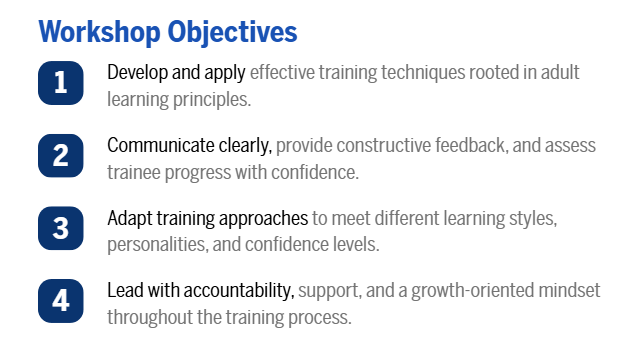
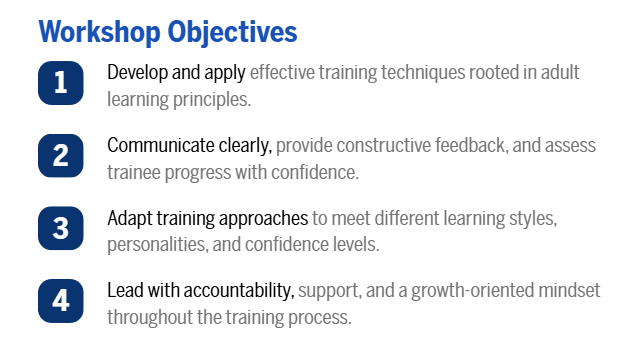
The training program introduced adult learning theories and created opportunities for participants to actively practice scaffolding, assessing, and communicating through interactive in-person activities. I facilitate these trainings, but designed the program to be delivered by any qualified coach. Take a look at some of the materials used in the training program.
Audience
Frontline manufacturing workers who are the SMEs of their area and are tasked with onboarding new team members.
Responsibilities
Tools Used
Facilitator & Coach
Instructional Design
Needs Analysis
Material Development
Adobe Creative Suite
Freepik Generative AI
PowerPoint
Claude AI
Canva








The Challenge
New hire training was inconsistent across teams, with frontline workers expected to train new employees without formal preparation. This led to variable onboarding experiences, longer ramp-up times, and frustrated trainers who felt unprepared for the responsibility.
Business Impact:
Inconsistent new hire performance across locations/shifts
Extended time to productivity (example: 16 weeks vs. target of 10 weeks in one department)
Frontline workers feeling overwhelmed by training responsibilities
Knowledge gaps in critical safety/quality procedures
My Role & Approach
As the Technical Trainer striving to develop the frontline trainers, I:
Design Philosophy: Frontline workers are subject matter experts but often haven't been taught how to teach. During these training sessions, participants would share with each other how they worked through different issues that arise, while also saving space for self-reflection. This workshop honored their expertise while building practical training skills they could use immediately.
Partnered with operations managers and experienced frontline workers to identify training pain points.
Designed a 5 hour train-the-trainer workshop that can be delivered in a half day or over the course of 5 weeks.
Delivered hands-on training to 16 frontline workers across 2 cohorts.
Created job aids and tools to support ongoing training efforts.
Evaluated program effectiveness through trainer feedback and new hire performance metrics
Impact & Results
Participant confidence surveys (pre/post workshop)
Trainer skill demonstrations during workshop
New hire performance tracking (trained by workshop graduates)
Feedback from operations managers
87% of trainers reported increased confidence in training new hires.
New hire time-to-proficiency reduced by almost 50% in some departments.
Operations managers reported higher quality onboarding.
Evaluation Approach
Key Results
What I Learned
Frontline workers responded incredibly well to practical, hands-on training. The "practice teaching" exercises built confidence immediately, and trainers appreciated having standardized tools that made their job easier. The peer feedback component created a supportive learning community.
After the first cohort, I received feedback to build more hands-on activities into the program. The first group of participants expressed their gratitude for practicing conversational tone and answering questions, so I incorporated more of these opportunities into the training for the next group.
I also learned a great deal about coaching other leaders throughout this experience. Many participants found so much value in hands-on practice with the soft skills, and in reality this looked like a lot of role-play, branching scenarios and taking turns having hard conversations. Several of them presented real situations they encountered and as a group we were able to reflect and reinvent the conversation. I was able to model how I would handle different situations, and they were able to implement the tools in their next training.
The best training programs don't just transfer knowledge; they build confidence and capability. Frontline workers often have the expertise but need structure, tools, and practice to become effective trainers. This project reinforced my commitment to designing practical, job-embedded learning that respects learners' time and expertise. I found fulfillment in helping them reach new goals they had dreamed for themselves.